
Visit our sister brands


When someone you love starts needing more help at home, the question of how to pay for it often comes up sooner than you'd like. It can feel overwhelming, especially when you're already worried about them, and the finding system isn't always easy to make sense of.
The good news is that there's more support out there than many families realise. Whether you're paying for care yourself or hoping for help from the NHS or your council, this guide explains how each option works so you know where to start. The rules here apply in England, as Scotland, Wales and Northern Ireland each do things a little differently.
For most families, the first step is a free needs assessment from your local council. A social worker or occupational therapist will talk to your loved one about the help they need day to day, like washing or getting dressed, and whether they're eligible for support. You can request one through your council's adult social care team, and the NHS has a simple guide to getting a needs assessment.
If the council agrees your loved one needs support, they'll usually carry out a financial assessment next. This looks at their income and savings, and decides how much the council will put towards the cost of their care.
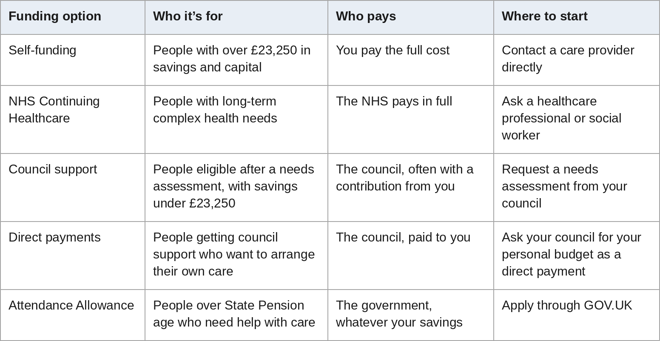
In England, if your loved one has more than £23,250 in savings and capital. they'll usually need to pay for their own care. This limit is set by the government and is staying the same for 2026 to 2027.
If their savings are between £14,250 and £23,250, the council will help but they’ll be asked to contribute, and below £14,250 their savings aren’t taken into account.
One thing that surprises a lot of families is that if your loved one is getting care at home, the value of their home isn’t included in the financial assessment. It’s usually only taken into account if they move into a care home, so the council won’t count the family home when working out what they pay.
Even if you're self-funding, it's worth checking whether your loved one can claim Attendance Allowance. It's for people over State Pension age, and it isn't means-tested, so their savings won't affect it. It's currently £76.70 or £114.60 a week depending on how much help they need, which can go a long way towards the cost of care.
NHS Continuing Healthcare is free care that's arranged and fully funded by the NHS, for people with long-term complex health needs. It isn't based on a particular diagnosis but on the level of care someone needs, and it can be provided in their own home.
The process usually starts with a short checklist, which a healthcare professional or social worker can complete. If it suggests your loved one may qualify, they'll be referred for a full health needs are complex or changing quickly, especially if they're coming home from hospital.
If the council is contributing to the cost, the amount they'll pay is called a personal budget. They can arrange the care for you, or you can ask for the money as a direct payment so you can arrange it yourself.
Direct payments give families much more say over who provides their care. According to the NHS, you can use them to employ your own carer or to pay for care through an agency. Going though an agency means you won't have to deal with things like payroll and pension contributions, which many families find much easier.
If all of this feels like a lot, you're not alone. Most families are trying to get their heads around assessments and funding while still looking after someone they love, and that's a lot to carry on your own. That's where we come in, so you can focus on your loved one and leave the rest to us.
Whether your loved one needs a few visits a week or someone with them around the clock, we'll build their care around their routines and preferences, and adjust it whenever their needs change. Every one of our carers is vetted and DBS checked.
Give us a call on 0330 818 1414 or request a call back, and we'll talk through your options together.

What does a Domiciliary Care Worker do? Domiciliary Care Workers, also known as home carers, assist with essential daily activities such as personal care, medication management, and household tasks...
Read
Children's Support Workers provide hands-on care, from assisting with daily routines and school activities to offering emotional support during challenging times. They help children develop life sk...
Read
Young Adult Support Workers assist with developing life skills, offering emotional support, and providing practical help with daily tasks such as budgeting, personal care, and job readiness. Whethe...
Read
Comparing live-in care with a care home? Discover the real costs, what’s included in the fees and the key factors to consider when choosing the right care for your loved one.
Read